Signs Your Well Pressure Tank or Pressure Switch Is Failing
The tank and the switch are the two cheap parts that decide how hard your well pump has to work, so their warning signs are worth knowing.
October 7, 2026 · 4 min read
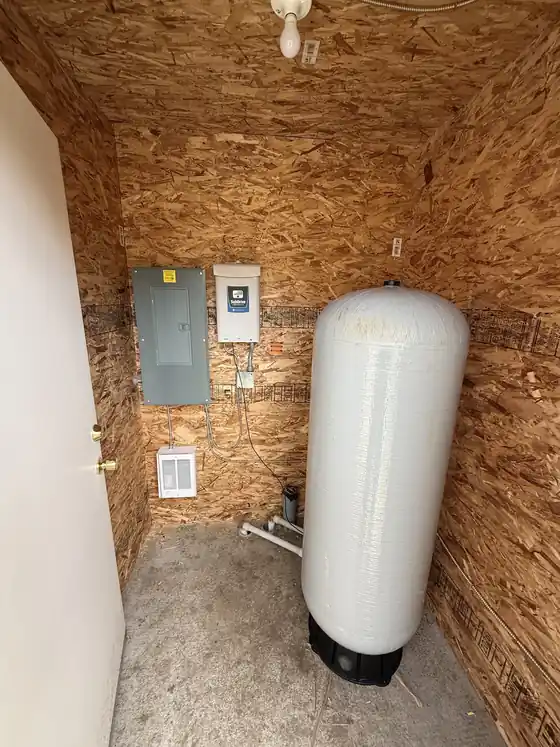
Most people think about their well pump only when the water stops. But the pump has two quiet partners that decide how hard it works every day: the pressure tank and the pressure switch. When either one begins to fail, it rarely announces itself with a bang. It shows up as small oddities at the faucet and small noises at the pump house. Catching them early is usually the difference between replacing a tank and replacing a tank plus a burned-out pump.
What the tank and switch actually do
The pressure tank stores water under pressure so the pump does not have to start every time you rinse a glass. Inside, a rubber bladder or diaphragm separates a cushion of compressed air from the water. When you open a tap, the cushion pushes water out, and the pump only kicks in when pressure drops to the cut-in setting.
The pressure switch is the traffic cop. It senses pressure and closes the circuit to start the pump at the cut-in setting, then opens it at the cut-out setting. Between them, the tank and switch decide how often the pump runs and how long it rests. A wrong setting or a failing part on either one makes the pump work harder than it should.
Signs the pressure tank is failing
- The pump cycles rapidly. If the pump starts and stops every few seconds, the air cushion is probably gone and the tank is waterlogged.
- Pressure swings. The shower runs strong, then weak, then strong again as the pump catches up.
- Sputtering faucets. Air can move through the lines when a bladder has failed, and it comes out as spitting and surging at the tap.
- Water at the air valve. Press the little valve stem on the tank, like a tire valve. If water comes out instead of air, the bladder has ruptured.
- A dull sound all the way up the tank when you knock on it, instead of hollow on top and dull on the bottom.
- Visible rust, a bulged shell, or a puddle at the base of the tank.
A tank that has simply lost some air can sometimes be recharged. A tank with a split bladder cannot, and it should be replaced rather than topped off again and again.
Signs the pressure switch is failing
- The pump will not start even though the pressure gauge reads low and the breaker is on.
- The pump will not shut off, and the pressure keeps climbing past where it normally stops.
- Chattering or buzzing from the switch box at the moment the pump should start.
- Burn marks, pitting, or a smell of scorched plastic around the contacts. This one is for a licensed electrician only, with the power off.
- Pressure that cuts in or out at a number different from last year, because the settings have drifted or a spring has weakened.
- A clogged supply tube, where the gauge reads normal but the switch never gets the message.
The switch is a small, inexpensive part sitting on a lot of wiring. Replacing it is routine work, but it is also line-voltage work, so it belongs to someone with electrical credentials. Castle Pump & Electric holds a Washington electrical contractor license alongside its pump work, which matters on exactly this kind of call.
Why a bad tank can wreck a good pump
A failing tank or switch rarely stays a small problem. When the tank is waterlogged, the pump starts many more times each day, and every start sends a surge through the motor. Heat builds, contacts wear, and a pump that could have run for years starts to fail early. When the switch sticks closed, the pump can run past its normal limit and overwork the whole plumbing system. It is common for a customer to replace a dead pump only to find the tired tank that killed it still sitting there.
A quick checklist before you call
None of this replaces a service visit, but a few observations make the visit faster. Write down what the pressure gauge reads when the pump starts and when it stops. Note how long the pump runs and how long it rests. Listen for clicking, buzzing, or humming without water movement. Check whether the cycling happens only when someone is using water or also when everything is off. And look at the tank for rust, wet insulation, or stains at the base.
Repair, replace, or upgrade
When the tank is finished, a replacement sized to your pump and your household fixes the problem. When the switch is the culprit, a new switch set to match the system settings usually does. For some properties, especially those with swings in demand like a house plus a barn plus a garden, a SubDrive or VFD is worth a conversation. These controls vary motor speed to hold steady pressure and cut out the constant start and stop pattern. Castle Pump & Electric works with Grundfos, Franklin, and Square D equipment, and the crew can tell you honestly which fix fits your well.
If your system is showing any of these signs, our pump components and controls page at /well-pump-services/pump-components-and-controls covers tanks, switches, SubDrive systems, and pump houses. When it is time to book, call (509) 580-0470. The line is open 24 hours a day, and most pump repairs can be finished the same day, depending on the issue and parts availability.
Castle Pump & Electric, (509) 580-0470
Call (509) 580-0470More articles
Why Does My Well Pump Keep Turning On and Off?
A pump that clicks on and off every few seconds is telling you something upstream is wrong, and it is usually cheaper to fix before the motor pays for it.
Common Irrigation Pump Problems and When to Call for Repair
Irrigation pumps tend to fail at the worst moment, in the middle of the growing season, so knowing the warning signs is worth the time.