Mast · Yakima Valley
Landscape lighting installed in the Yakima Valley
Path, garden and facade lighting with properly rated underground cable, weather-resistant connections and correctly sized transformers.
Chapter 01
Why cheap landscape lighting quits after one winter
Most failed landscape lighting fails for the same three reasons. The transformer is too small for the number of fixtures hanging off it, so the lights at the far end run dim or flicker. The cable is not rated for burial, so moisture works through the jacket. And the splices are twisted together and wrapped in tape, so they corrode the first time the sprinklers hit them.
The Yakima Valley is hard on outdoor electrical. Summer sun bakes anything exposed, irrigation soaks the ground on a schedule, and winter freezes it. A kit from a box store can look fine on the day it goes in and be a string of dead fixtures by spring. Fixing that is not about buying brighter lamps. It is about the parts you cannot see.
Castle Pump & Electric is an electrical contractor first, licensed in Washington under CASTLPE842NN, and the crew has been working in Yakima and Kittitas counties since 1991. That matters here because low-voltage lighting still has a line-voltage side: the outlet, the protection and the run from the house to the transformer. One licensed crew handles both halves.
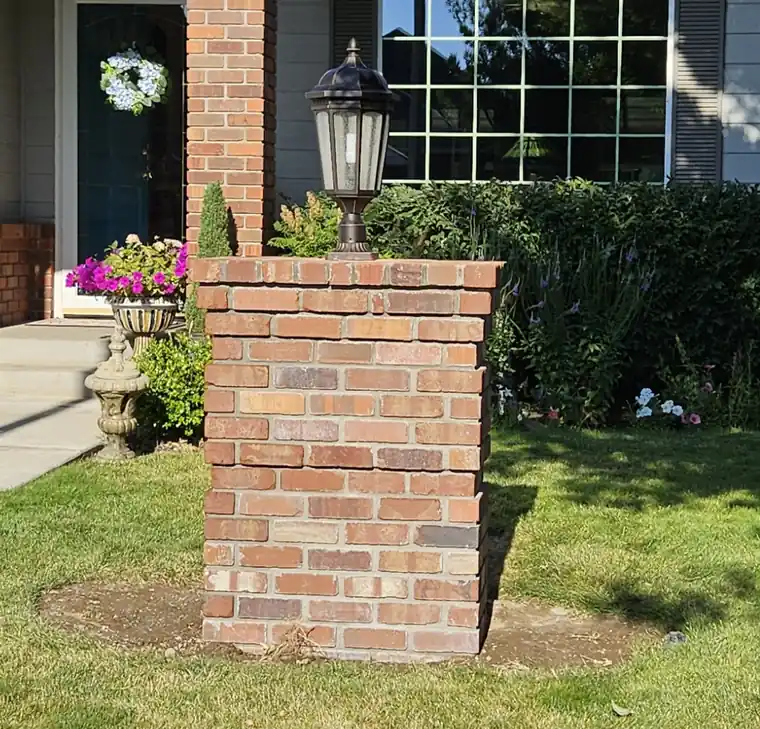
Coach lamp on a brick pillar among garden plantings
Rated cable, sealed connections, sized transformers
Castle describes its approach in three parts: properly rated underground cable, weather-resistant connections, and correctly sized transformers. Each answers one of the failures above. Burial-rated cable keeps water out of the conductor. Weather-resistant connections replace the taped splice. A transformer sized to the total load, with room left over, keeps every fixture at the same brightness from the first one to the last.
Sizing is plain arithmetic. Add up the wattage of every fixture on the run, pick a transformer that carries that load comfortably, and keep cable runs short enough that voltage does not sag before it reaches the last lamp. When a design needs more fixtures, the answer is a second run or a larger transformer, not squeezing more onto the one that is already full.
Where the cable goes matters before the trench is dug. A buried line that crosses a flower bed you replant every spring, or runs alongside a sprinkler line, is more likely to get cut by a shovel someday, so route planning is cheap at install and expensive afterward.
Chapter 03
Path, garden and facade, and the coach lamp on the brick pillar
Path lights keep steps and walkways readable without turning the yard into a runway. Garden lighting picks out a tree, a bed or a stretch of fence. Facade lighting washes the front of the house so the address and the entry are easy to find from the street. Each one wants a different fixture, a different spacing and a different brightness, and most yards use a mix.
One of the jobs in the crew's own photos is a black coach lamp on a brick pillar in a front garden, with garden plantings around it. It is a small thing, one lamp on one pillar, and it shows the point of the work: the fixture is the part people see, and the wiring behind it is what decides whether it is still lit three years from now.
Landscape lighting often goes in with other outdoor work, such as a hot tub circuit, a gate operator or a patio kitchen, and it is cheapest to plan it with them while a trench is already open. Call (509) 580-0470, tell Rob what the yard looks like, and the crew will tell you what it takes. Estimates are free and usually ready within 48 hours.
“It's clear that Rob and his team truly care about their customers and take pride in their work.” Jocelyn Tinoco, Google review, 5 stars, Castle Electric LLC, Yakima.